
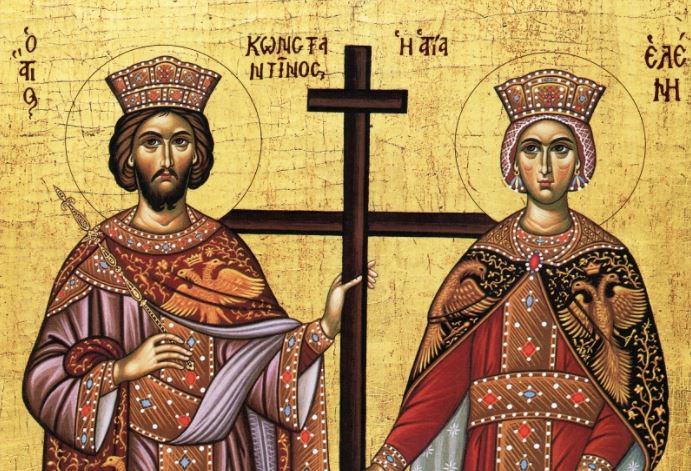
The Church today venerates the memory of Constantine and Helen, Equal-to-the Apostles.
The great and renowned sovereign was the son of Constantius Chlorus – the ruler of the western-most parts of the Roman empire – and of the blessed Helen.
In 312, upon learning that Maxentius and Maximinus had joined forces against him, he marched into Italy, where, while at the head of his troops, he saw in the sky after midday, beneath the sun, a radiant pillar in the form of a cross, with the words: “By this shalt thou conquer.”
The following night, the Lord Jesus Christ appeared to Constantine in a dream and declared to him the power of the Cross and its significance. When the emperor arose in the morning, he immediately ordered that a military standard be fashioned in the form of a cross, and he inscribed on it the name of Christ.
On the 28th of October, he attacked and mightily conquered his rival, who drowned in the Tiber while fleeing.
As ruler of both East and West, Constantine ended all persecutions against the Church.
In 324, in the ancient city of Byzantium, he laid the foundations of the new capital of his realm, and solemnly inaugurated it on May 11, 330, naming it after himself, Constantinople.
Falling ill near Nicomedia, he requested to receive divine Baptism. He reposed in 337, on May 21 or 22, the day of Pentecost, having lived 65 years, of which he ruled for 31.
As for Constantine’s holy mother Helen, after her son had made the Faith of Christ triumphant throughout the Empire, she undertook a journey to Jerusalem and found the Holy Cross. After this, St. Helen, in her zeal to glorify Christ, erected churches in Jerusalem at the sites of the Crucifixion and Resurrection; in Bethlehem, at the cave where the Savior was born and elsewhere.

